
 Discipline feels hard because you’re fighting your brain.
You’ve tried willpower. You’ve set goals. You’ve made promises to yourself at 6 AM that dissolve by noon.
Podcast – Yoga: Rewiring the Brain for Discipline
The problem isn’t your character. It’s biology.
Video – Yoga for Self Discipline
Your brain runs on efficiency. It automates behaviors to save energy. When you rely on willpower alone, you’re asking your prefrontal cortex to override deeply embedded patterns with brute force.
That’s exhausting. And it doesn’t last.
Yoga works differently. It rebuilds the architecture.
Your Brain on the Mat
MRI studies reveal something striking about regular yoga practitioners. Their brains look different.
Specifically, they have a thicker cerebral cortex and larger hippocampus compared to non-practitioners. These are the regions responsible for information processing, learning, and memory.
Think of it as weightlifting for your brain. Each practice session strengthens the neural pathways that support self-regulation.
But here’s what matters more than structure: function.
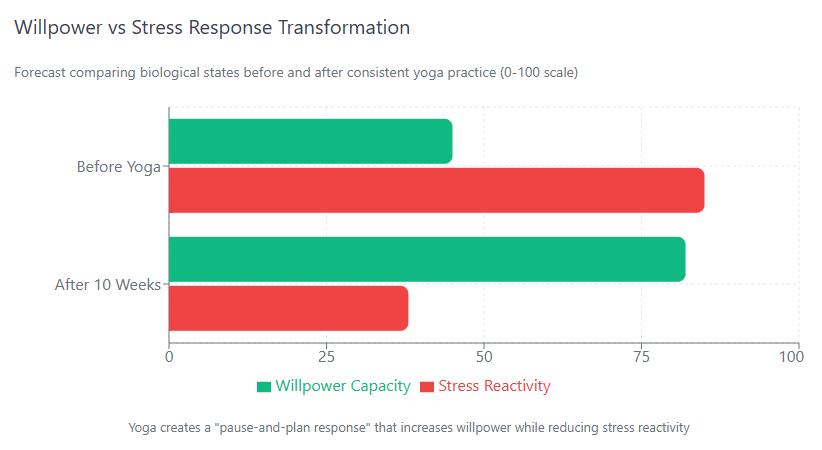
Yoga creates what researchers call a “pause-and-plan response.” Unlike the fight-or-flight stress reaction.
This biological state sends extra energy to your prefrontal cortex while keeping your body calm.
You’re literally training your brain to choose deliberately instead of react impulsively.
The biology of stress and the biology of willpower are incompatible. Chronic stress makes self-control harder.
Yoga reduces activity in your limbic system, creating a more tempered response to stressful situations.
You’re not fighting your brain anymore. You’re rewiring it.
 The Timeline That Actually Works
Forget motivation. Focus on repetition.
A 10-week yoga intervention with previously inactive participants showed increased adherence to physical activity long after the study ended. Twice weekly was enough to shift behavior patterns.
The mechanism? Synaptic connections.
When you repeat a behavior consistently for 21 to 30 days, your neurons form stronger connections.
The pathway becomes myelinated, wrapped in a fatty substance that makes signal transmission faster and more efficient.
This is muscle memory at the neurological level.
After enough repetition, the behavior becomes automatized. You don’t need willpower to maintain it. Your brain’s built-in systems keep you on track.
Medical students in a yoga and mindfulness course showed significant improvements in goal-directed behavior regulation.
Young children in an 8-week intervention demonstrated gains in behavioral self-regulation and declines in teacher-rated behavior problems.
The pattern holds across ages and contexts.
Best Practices for Building Discipline Through Yoga
1. Commit to the Same Time Daily
Your circadian rhythm influences willpower. Choose a consistent time slot and protect it.
Morning practice leverages higher cortisol levels, which support alertness and decision-making. Evening practice can anchor your wind-down routine.
The specific time matters less than the consistency. You’re training your brain to anticipate the practice, reducing the activation energy required to start.
2. Start With Breath Control
Pranayama isn’t just breathing. It’s executive function training.
Both slow and fast breath control practices improve reasoning, decision-making, memory, learning, and reaction time. A 12-week pranayama study showed significant improvements in attention span.
Begin with simple techniques. Slow nasal breathing at 2.5 breaths per minute induces parasympathetic dominance, the biological state where self-control thrives.
Five minutes of focused breathing before your physical practice primes your nervous system.
3. Progress Gradually, Not Dramatically
Discipline builds through accumulated small wins, not heroic efforts.
Start with 15 minutes. Master basic poses. Focus on form over complexity.
As neural pathways strengthen, increase duration and difficulty. But never sacrifice consistency for intensity.
Research shows willpower predicts success better than IQ. Unlike IQ, self-control can be cultivated through practice.
You’re not testing your limits. You’re expanding your baseline.
4. Track Streaks, Not Perfection
Your brain responds to visible progress. Mark each practice day on a calendar.
The streak itself becomes motivation. Breaking it creates psychological friction.
Miss a day? Start a new streak immediately. The goal is pattern establishment, not flawless execution.
5. Link Practice to Identity
You’re not someone who does yoga. You’re a practitioner.
This subtle shift in self-concept changes behavior at the root. Identity-based habits are more resilient than outcome-based habits.
When your practice aligns with who you believe you are, maintaining it requires less conscious effort.
This all-round discipline? It sets you on this balanced, feel-good path.
| Benefits | Description |
|---|---|
| Clarity of Mind | Yoga discipline helps in quieting the mind, reducing mental clutter, and gaining clarity of thought. |
| Reduced Stress and Anxiety | Regular yoga practice promotes relaxation, reduces stress hormone levels, and alleviates anxiety. |
| Cultivation of Peace | By embracing the discipline of yoga, one can develop a sense of inner peace and serenity. |
| Increased Self-Awareness | Through yoga practice, individuals deepen their understanding of themselves and their emotions, fostering self-awareness and self-acceptance. |
| Enhanced Connection with True Self | Meditation practice, a crucial component of yoga, allows individuals to tap into their true essence and experience a deep connection with themselves. |
| Development of Compassion | Yoga discipline cultivates compassion towards oneself and others, promoting empathy and understanding. |
The Compound Effect
Discipline isn’t a personality trait. It’s a skill you build through deliberate practice.
Yoga provides the framework: consistent repetition, mindful attention, controlled breathing, progressive challenge.
Each session strengthens the neural infrastructure that makes self-regulation easier. The practice becomes less effortful over time because your brain physically changes to support it.
You’re not forcing discipline. You’re growing it.
The mat is where you train. Your life is where you see the results.
